Data Protection and Privacy
"Protecting memories with light and intelligence."
Halo EYEQ is committed to protecting your precious memories with the utmost technology and care.
Here, we explain in detail how we handle the data we receive from you, especially "facial data," with illustrations.
1. Where Your Facial Data for Authentication is Stored
Conclusion: Not on the server, but only in your browser (device).
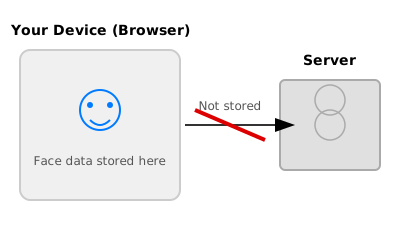
When you use our service, we register and authenticate your face for identity verification. The facial features obtained at this time (numerical data representing the positions of eyes, nose, etc.) are never stored on our servers.
Facial data is stored only in a very secure dedicated area within your smartphone or PC browser.
When you search for photos, this facial data is temporarily sent to the server only for search purposes, but is immediately discarded from the server memory as soon as the search is complete. This means that even if there is unauthorized access to the server, there is no risk of your facial data being leaked.
2. Mechanism for "Facial Data in Uploaded Photos"
Conclusion: Facial features are stored by a third party (AWS), and only IDs that cannot be linked to individuals are stored on our servers.
Facial data from photos uploaded at events is managed in a distributed manner to maximize privacy protection as follows:
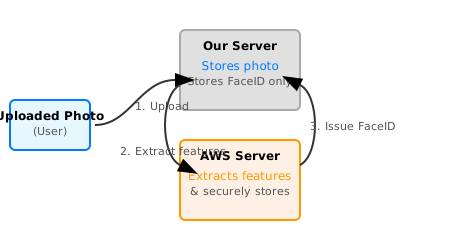
- Photo Storage: The original photo data uploaded is securely stored on our servers.
- Feature Extraction: Only the face parts are detected from the photo and their features are converted into numerical data (feature points). This processing is performed by Amazon Web Services (AWS) facial recognition service, which boasts world-class security standards.
- Feature Point Storage: The converted facial feature points are stored in a very secure area of AWS.
- Only IDs Stored on Server: AWS issues a random ID (FaceID) that is completely unlinked to individuals for the stored feature points. Only this FaceID and photo-related information are stored on our servers.
This mechanism ensures that the facial "features themselves" are not stored on our servers. Since IDs alone cannot identify individual faces, data is kept extremely secure.
Other Security Measures
1. Private by Default
Uploaded photos are never made public. Only the person in the photo (or their guardian) who has completed strict identity verification can view their own photos (low-resolution preview).
2. You Can Manage Your Own Photos
You can request deletion of photos in which you appear at any time from the viewing screen.
3. Data is Completely Deleted After a Set Period
All uploaded original image data is automatically and completely deleted 30 days after the event ends. We do not reuse or continue to store data.
Halo EYEQ promises to continue to be a place where you can safely entrust your precious memories, both technologically and ethically.